May 25, 2006

Scotland, Day 3 Part 1 - St. John's Kirk

Q. Shenaynay

(click on photos to enlarge)

It's been said that the mind is like a rubber band -- once it's been stretched, it can never go back to its original dimensions. Day 3 in Scotland was a rubber band sort of day. Even now, two short months later, it still seems unreal, like something too big to squeeze into my life story, surely... no, no really, that must have happened to someone else.

That sort of day.

Day 3 was Sunday, March 26, THE big day of the coronation festivities. We had been apprised of the basic itinerary for the day, but again, we really had no idea what to expect. The only thing we knew for sure was that Lord Elgin was having The Bus come around for us at early-thirty, and would keep us hopping - to three separate events! - until very late that night.

The dapper bus driver arrived, greeted us with great cheer in something akin to English, and then glided us through the hour-long journey northward to Perth. There we were to start the day with a special service at St. John's Kirk, which we were told was an ancient and important church in Scottish history, of the "Church of Scotland in the Reformed Tradition" variety.

Now, my fingers could atrophy on this keyboard waiting in vain for me to conjure up fitting words to describe everything that floated by outside the windows of the bus en route from Dunfermline to Perth. So please allow me to merely repeat myself: SCOTLAND IS BEAUTIFUL.

I kept waiting to round a corner that would reveal some ratty little enclave or a guilty pile of rubbish, but it never happened -- the land grew more enchanting as we headed north. All those familiar illustrations of A.A. Milne and Beatrix Potter and James Herriott -- why, there they were! And their peculiar watercolored words spoke themselves in my head: hedgerow, spinney, stile, copses, rockery, gorsebush... all those things... just rolling by like it was the most natural thing in the world.

There were too many scenes begging for my notice. Overwhelmed, I simply turned off my camera and settled back to see what tricks the scenery would do next. How could anyone not live happily ever after in a place like that? I wanted all my loved ones to stroll into the scenery, the way Gene Kelley and Van Johnson just felicitously happened upon Brigadoon. Aye, can't you see us? We're all rrrroamin' through the heather on that hill over there, singing some old hymn -- the kind that still remember the piper's drone. Aye!

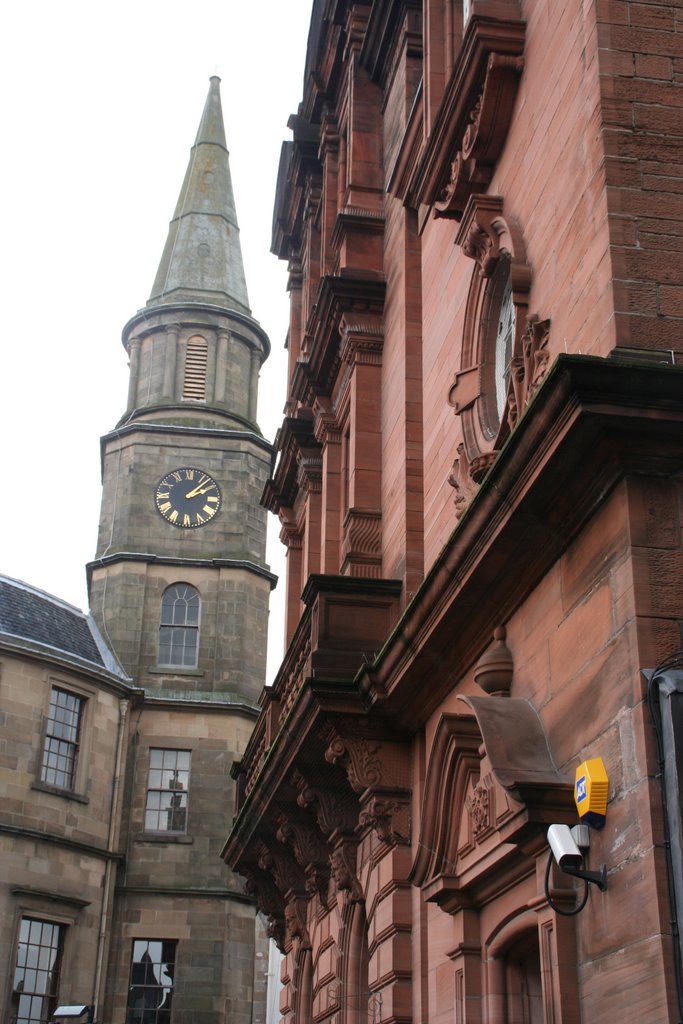
A wide river sidled up alongside the road, running so swiftly it appeared to be on fast-forward -- the legendary River Tay, known for its silver hue and its wild salmon. And then, just-like-that, the city of Perth blinked into view. The spire of the kirk seemed to rise from the river banks at the heart of the burgh.

St. John's Kirk has played a pivotal role in Scottish history. The first mention of its existence is dated 1128. It was here in 1599 that John Knox ignited the Scottish Reformation by preaching a fiery sermon against idolatry. When he finished, a priest approached to celebrate mass, and was hit by a stone thrown from the congregation. A riot erupted in which the church was stripped of all Catholic fixtures (though the building itself was not damaged). The riot raged across Perth for several days, during which the three area monasteries were also bared to the walls... and thus the Scottish Reformation began in earnest.


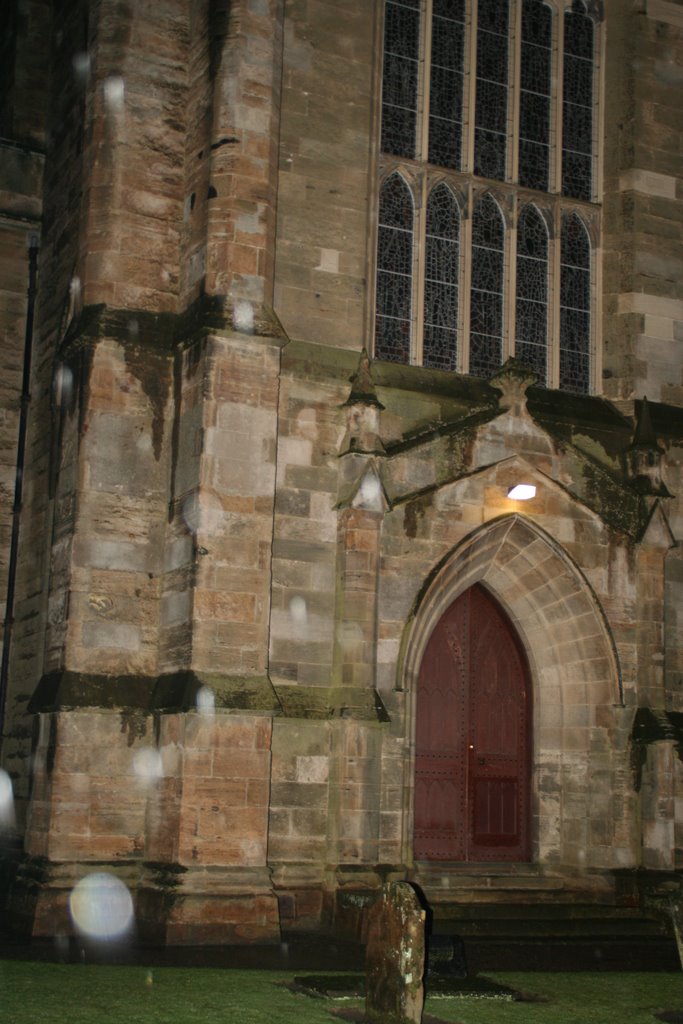
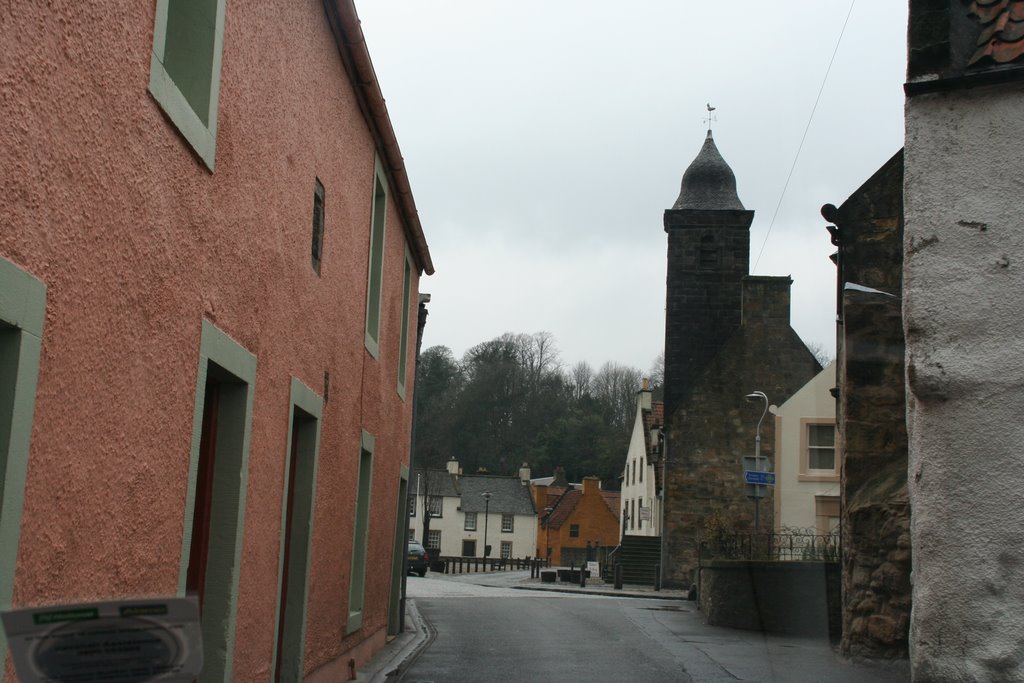
Here, arriving early, we are greeted at the door by Charles Bruce, the very amiable second son of Lord Elgin. The church is larger than it appears in this photo.


This, my friends, is a 900 year old sanctuary. Let's put it this way: if you've read somebody's name in a Scottish history book, you can pretty safely assume they've been here.
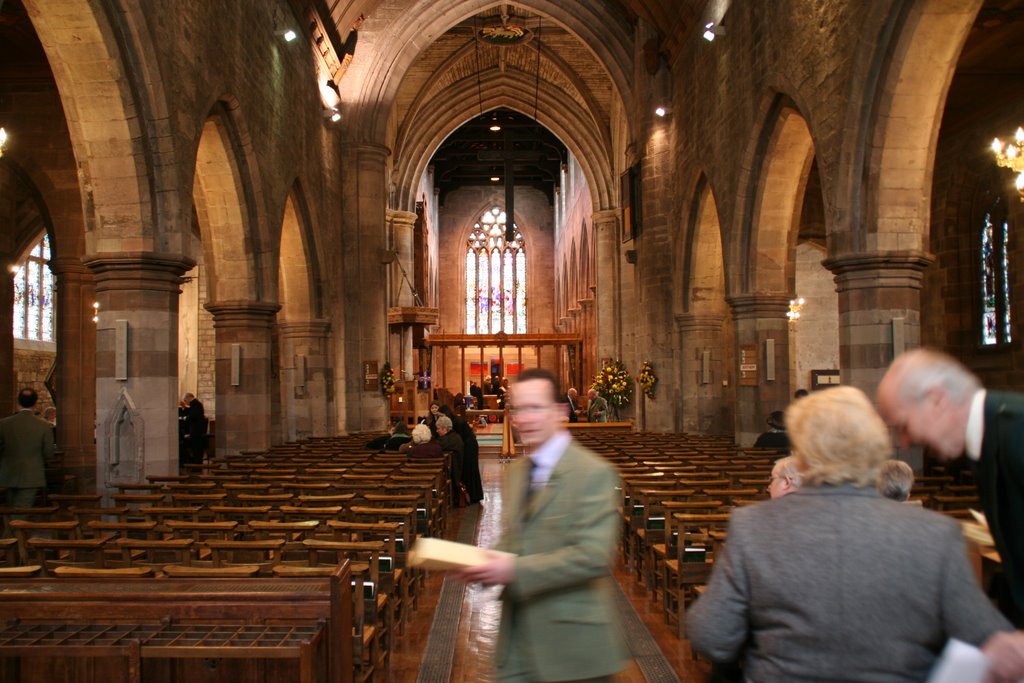


We were among the first to arrive, and were ushered to the front transept which was reserved for the Bruce entourage.

Soon BBC camera crews began to arrive, as well as Lord Elgin's own videographers who made a commemorative DVD of the day's events. Photographers set up camp in every spare corner. We began to suspect we were in for Quite A Morning. We were right.


Settling into our reserved seats while the Scottish National Fiddle Orchestra plays right next to us -- lovely!
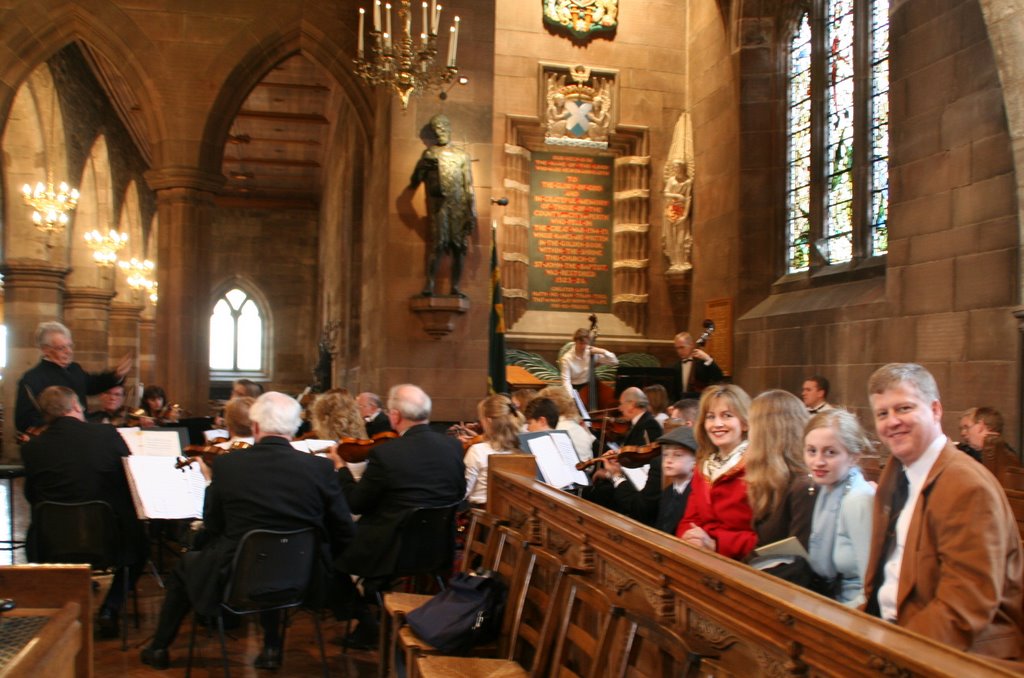


The service was quite magnificent! It began with a grand processional that included pipers and two choirs. Then a whole slew of dignitaries filed in behind Lord Elgin, who, it turns out, is the head of the Church of Scotland (news to us!). An Earl of something or other carried Robert the Bruce's broadsword down the aisle, held high in the air -- what a sight that was! There were several men in kilts and military regalia, and some Very Important Personages (unfamiliar to us, alas) wearing fur-lined robes and medals and all such as that. They settled into the reserved seats in the transept opposite from us.

And there we were on the front row with the BBC zooming in on us. I looked down at Justin to see his reaction. His eyes were drooping and he was struggling to stay awake, poor thing. Jetlag is powerful stuff.

Lord Elgin selected all the music for the service, choosing works that would span the centuries of Scotland's history. In addition to the Scottish National Fiddle Orchestra, he had also arranged for noted pipers, trumpeters and harpists to take part. The music was grand! It positively burst off those medieval stone walls.

The bishop explained that St. John's was the obvious venue for this special commemorative service in honor of King Robert's coronation because it was he who ordered its restoration in 1328, when it had fallen into disrepair.


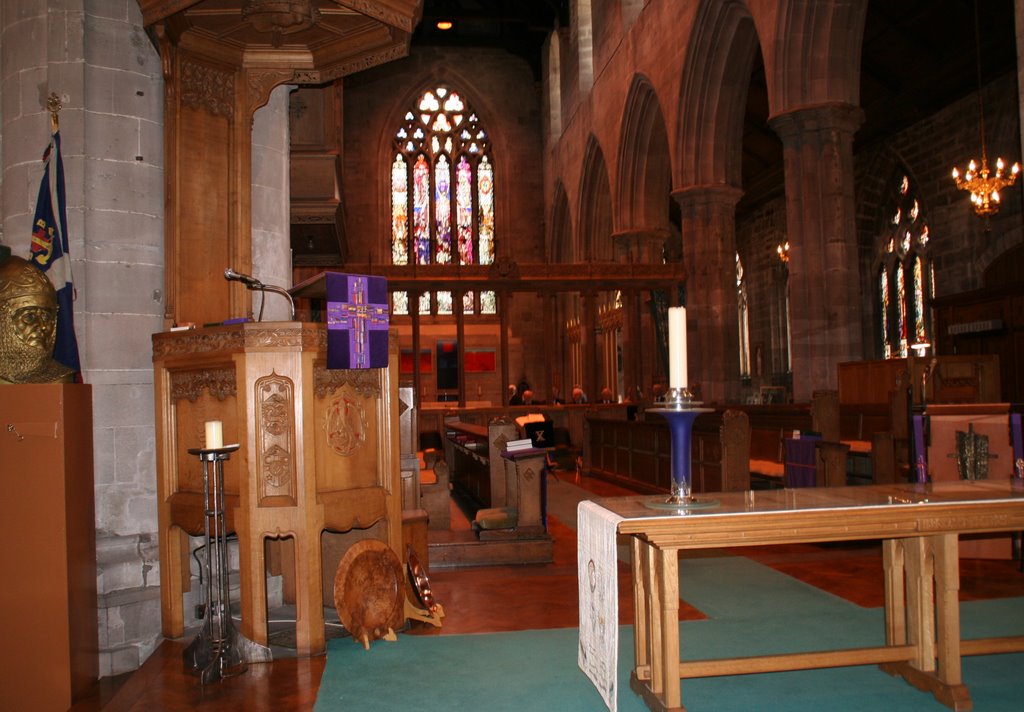
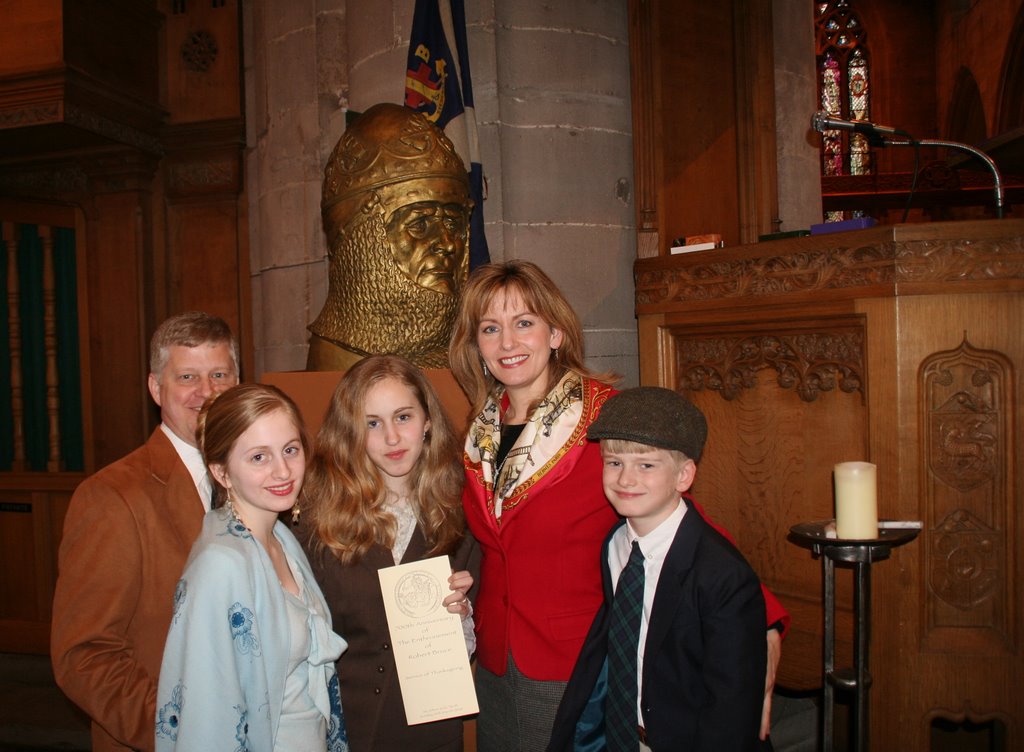
This is the pulpit from which John Knox preached that historic sermon. The choir area beyond it dates from 15th century. To the left is a bust of Robert the Bruce, brought in for this service. Robert's broadsword was brought forward and mounted on the pedestal below the bust -- just a few feet from where we sat. We struggled to keep our jaws closed.


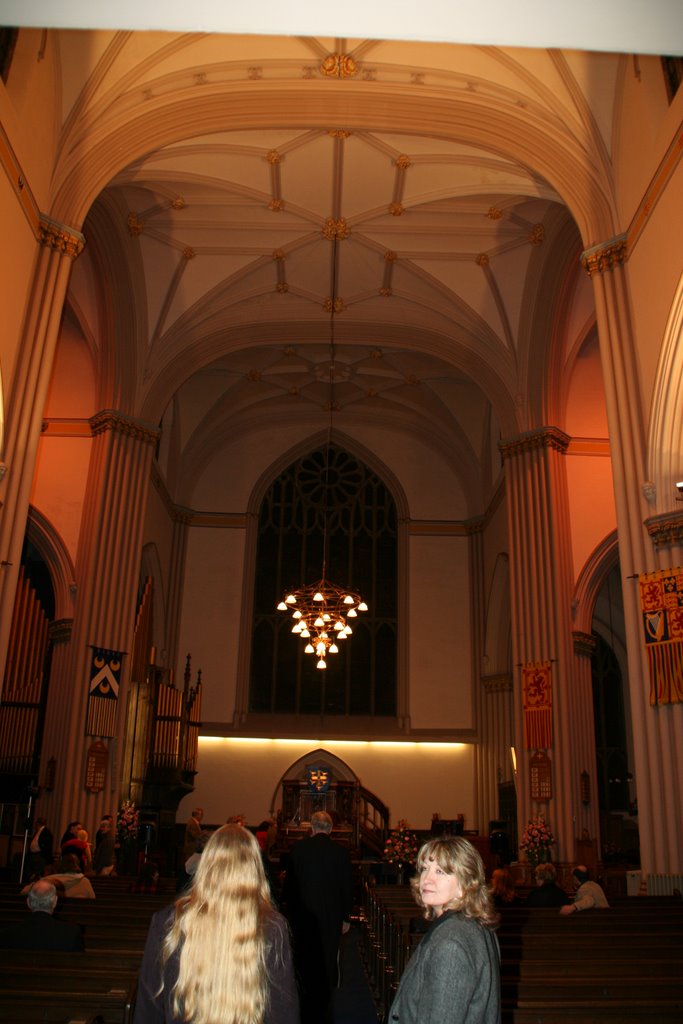
This immense vaulted wooden ceiling is a masterpiece of craftsmanship. I asked one of the ushers when it was built and she said something about it being "newer than some parts -- 16th century, perhaps." Newer. Right. Before it was installed, there were balconies there for members of the nobility and the royals.


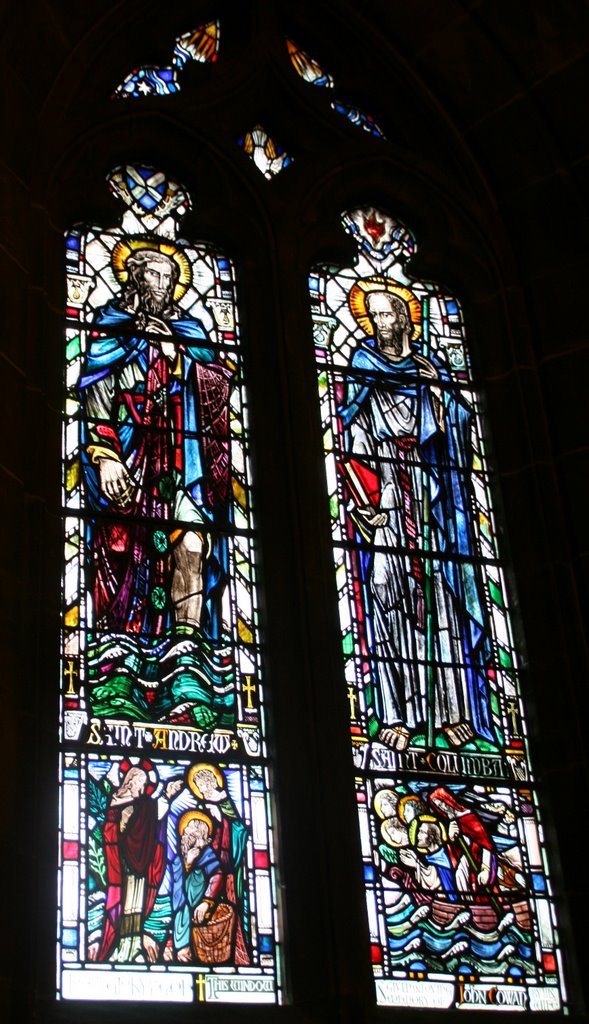
St. Andrew & St. Columba adorn this towering window - just one example of the stained glass in the sanctuary.


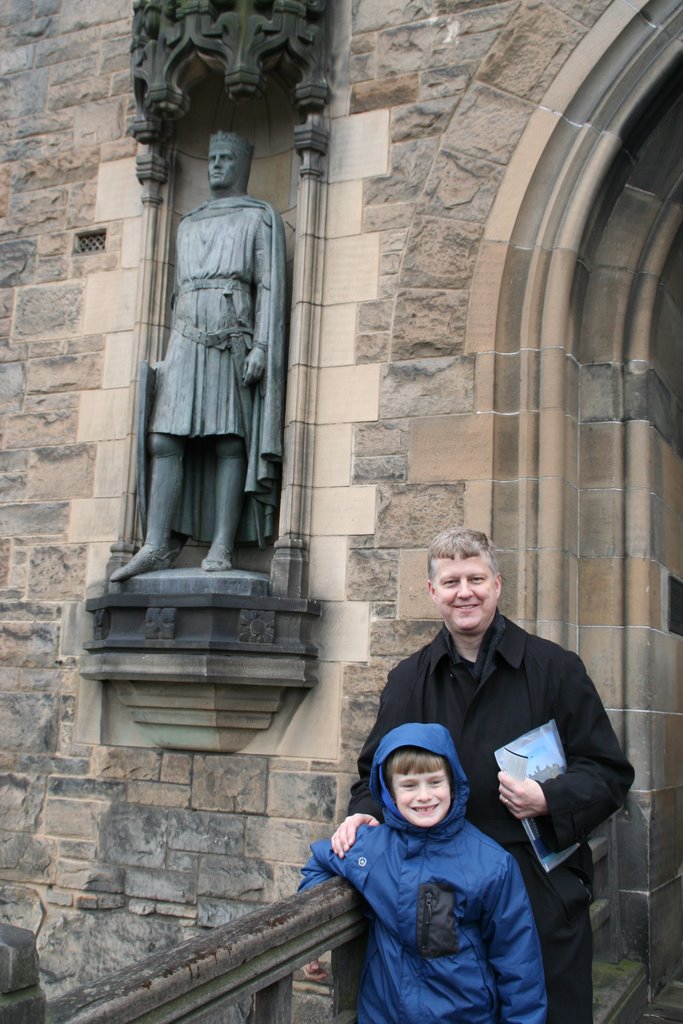
Posing with "Uncle Bob"

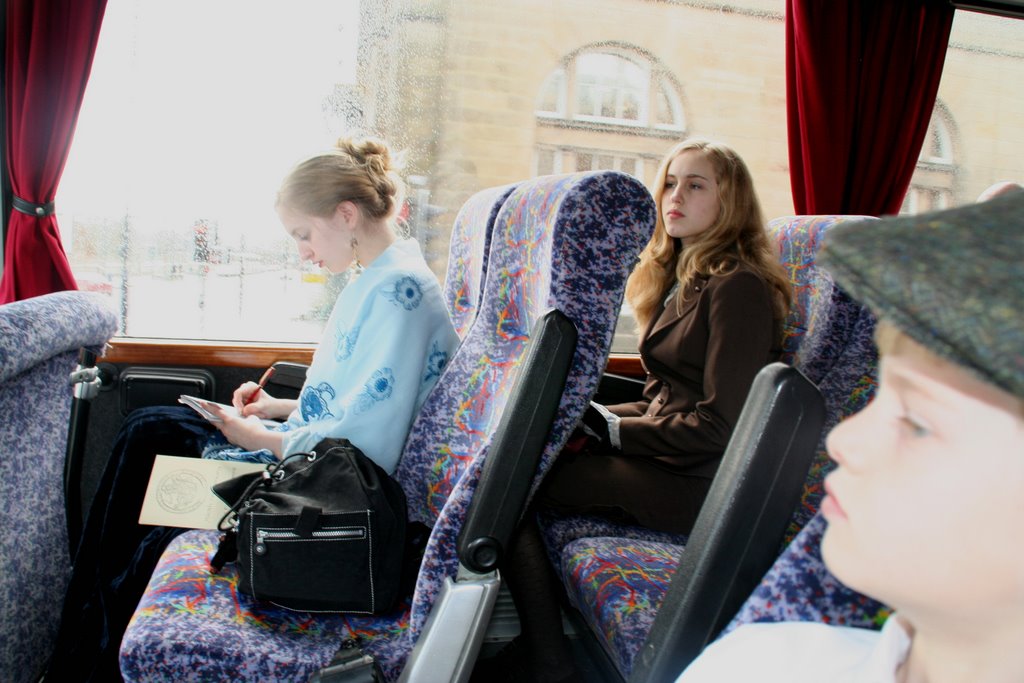
... and then back onto The Bus, where we scratched a few hurried and rather startled noted in our journals on the way to the festivities at Scone Palace...


... which is coming up next in Part 2!

* * * * * * * * * *

Here's a page on St. Johns Kirk's place in Reformation history

And their page on the history of the building

May 23, 2006

Day 2, Addendum 2 -- Stirling (sorry this is behind...)

Fa-so-la-la

More notes from my notebook--

"It's crazy how the people here just leave all this old stuff sitting around. Everyone keeps on living normally right around it, as if that statue over there was just another Starbucks. There are all these old buildings, many with the date of construction carved over the doorway, and the occasional castle, and memorials and statues everywhere. History is everywhere-- it's like Pooh says of the Jagular: "When you look up, it drops on you!" Everywhere you turn your eyes there's another old thing to look at. This place is heavy with the past like few places in America- maybe some of the homes of the founding fathers and such come close. But here it's everywhere."

"So after breakfast we took a little curvy road through the country to Stirling. It was incredible. The countryside is lush and moist to my eyes even in late winter. I want to drink the fields-- the green is the most perfect color. The colors here in general are so beautiful-- misty grey, purple-blue hills, rich brown, slate grey stone, luscious greens. None of the colors by themselves are especially splendid,but together they are perfect harmony.

I'm in a picture book-- Peter Rabbit should be crossing that field, or Pooh climbing out of one of those gorsebushes."

"Stirling itself is a truly amazing place. I wish I could spend a week here. There's this one old library we passed that I was just dying to go in. I mean, how fascinating to see what a Scottish library is like! Maybe next time.... ha. That's the problem with trips like this. I want to linger in all these places and go to libraries and grocers and department stores and restaurants and such. I want to walk everywhere. I see now why people do walking tours here-- it would be the best way to see things."

"Seen on gravestones in the Holy Rude graveyard--

'Alas for love, if that were all, and nought beyond the earth!'
'Accidentally Drowned'
(what other way is there to drown, I ask you?)"

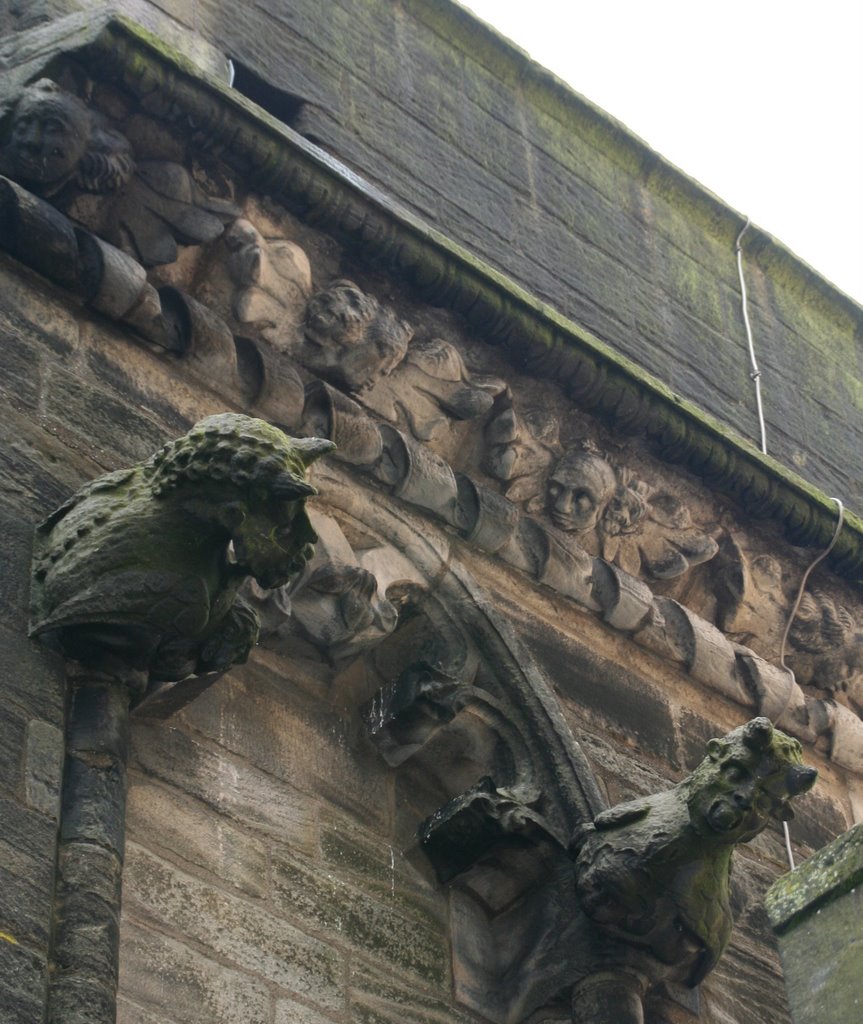
"You know everything I said about Edinburgh Castle? Well, I'm going to say it all again, only this time I mean it so, so much more. Oh my lands, what a place. I'm sitting here gaping trying to think where to start. For one thing, the architecture is incredible. Edinburgh was interesting chiefly because of its history, but Stirling is beautiful. There are the most incredible gargoyles; incredible not only for their age and the artistry in them but also for their bawdiness! Those people certainly weren't afraid of a little vulgarity. Some of these beasts are just truly obscene.

Edinburgh was strictly business, but at Stirling there are gardens and lawns and beautiful courtyards and terraces and rose bushes everywhere ! I would love to see this in June.

I wish I could describe the feeling you get here-- it's a strange combination of complete immersion in the moment and a detached bewilderment. It's all too large to understand, and yet there I am in it.

I wandered off by myself up a stairway and found a little terrace-walkway-thingy overlooking the bowling green. It was called the Prince's Walk, and it was built for James IV. I sat on the ramparts and thought myself into being a royal person up there, alone, sitting on that wall. It was rather terrifying. That must have been a life of constant fear."

I didn't write much about Stirling compared to what I experienced. I don't know if I could have.

May 21, 2006

Scotland, Day 2, Evening at the Abbey

Q. Shenaynay

(click photos to enlarge)

Before we dive into the evening of Day 2, a bit of background and context is in order. (You all know how we love context.)

In the months before the trip, we received, through our membership in an international organization of the Bruce clan, some sketchy news that some sort of event was being planned in Scotland for the 700th anniversary of Robert the Bruce's coronation as king of Scotland. We had no idea what to expect, but we were happy to at least have a concrete date to plan around.

We envisioned a few Americans clustered on the back row watching the kilted bigwigs do their ceremonial thing from a distance, and figured we would be touring around Scotland on our own.

Wrong.

Enter Lord Elgin, the British nobleman who is also Chief of the Bruce clan.

(A little cultural aside: Lord Elgin is a hereditary British title which for centuries has been passed on from father to eldest son. This current Lord Elgin's given name is Andrew Bruce, though nobody but close family calls him that, it would appear.)

We were to learn later that Lord Elgin had been looking forward to overseeing this celebration ever since he was a young lad, and had been for some time happily arranging exclusive celebrations specifically for Bruces coming to Scotland from abroad.

Out of the blue we received a letter from him, on very hoo-hoo stationery, welcoming us -- yes, us, your lowly Beehive buddies -- to Scotland. Huh.

Soon a second letter arrived, peppered with very proper sounding phrases advising us of "events definitely arranged" and offering helpful tidbits on proper dress, like this spiffy little quote which immediately worked its way into common Beehive lingo: "You will never go far wrong with smart casual." Oh, and the very kind and thoughtful tip that "the locals will favor tweeds." (Please do hear these in a droll British accent.)

There were also passing mentions of mysterious happenings such as "a medieval feast among friends at Scone Palace" and "a private supper at Broomhall" exclusively for Bruces visiting from abroad.

Huh. We began to get a little tingly. We stuck the letters on the fridge like good Americans, so our friends could gawk at them with us. We began to wonder what we were in for. We began to realize our suitcases were too small to carry all that Smart Casual stuff we wouldn't go far wrong wearing.

So, in a mildly tizzyish state we began to shop for larger luggage on the cheap, and combing the uppity consignment stores in the uppity parts of town for uppity Smart Casual Getups Such as One Might Wear to Broomhall... whatever that might turn out to be.

A particular variety of shriek began to punctuate the Beehive atmosphere:

"Mamadah, can I borrow your nice brown heels?"
(Well...no... well... oh alright.)
"Mamadah, where are my pearls?""
(Wherever you put them!)
"Mamadah, is blue velvet okay in late March?"
(I would think so if the locals are wearing tweed...!)
"Mamadah, we neeeeed to just skip school and go shopping!"
(Do I have to be a grownup today?)

~Et cetera~

So when we checked into our hotel in Dooon-FERRRM-lin (see Day 1), there was yet another letter from Lord Elgin awaiting us at the front desk. It said, among other things, "Your arranged transport will arrive at 6:30 tomorrow evening."

Arranged transport. Oh, how sweet it is! No dark and rainy night in the Peugeot deathtrap... Jesus loves me, this I know.

"Wait! What?? LORD ELGIN is sending us ARRANGED TRANSPORT???"

The letter also informed that we would be conveyed to "an evening of story and song at Dunfermline Abbey" with a "hot buffet to follow at Abbot House." Alrighty then. We had no idea what any of that actually meant, but baby, we had our Smart Casual and we were ready for anything. Arranged transport... oh yeah.

So after our day in Stirling and Bannockburn, we hurried back to the hotel as daylight faded, and dressed for the evening in a great ditherish flurry. We dashed to the lobby. A small cadre of assorted Bruces from Canada and the US were gathered there, all waiting to experience the phenomena of having nobility send for you via arranged transport. The buzz was palpable.

And then The Bus arrived. A huge bus. A towering white luxury tour bus with plush smushy seats and mood lighting and piped in Scottish music. A rock star bus. Huh.

The dapper chauffeur whipped that rig through tiny cobblestone streets and swirled through roundabouts like he was waltzing with Ginger Rogers. Great Scot felt waves of awe. We mostly felt relieved.

In mere moments we were at Abbot House, a warmly lit pink stone structure. The glowing windows spilled small hints of the cheery voices and medieval balladry lilting along within. In the dark sky, the shadowy outline of the immense abbey levitated like a spectre just beyond the glowing pink stones.

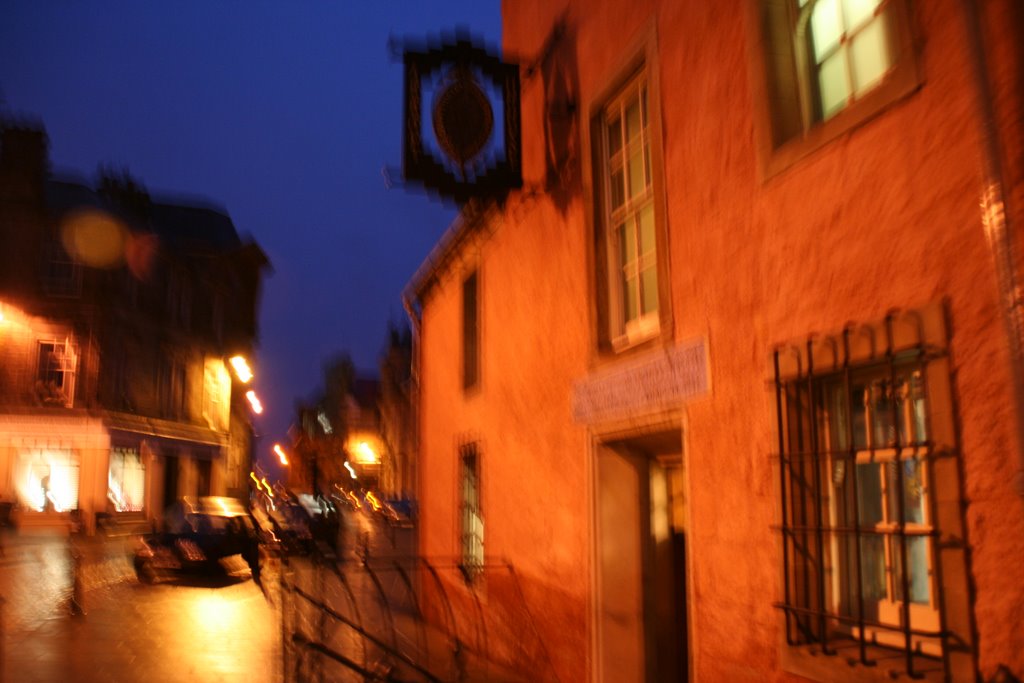
(This shot of the corner of Abbot House was taken from the bus window. I like it the blurry quality, actually -- it sort of captures how it feels in my memory.)


And then an amazing evening began.

Abbot House has been so many things since medieval times that it is rather hard to define. Situated adjacent to Dunfermline Abbey, it is the oldest house in the whole region. It has been not only an Abbot's home, but also a laird's mansion, an iron foundry, an art school and even a doctor's surgery. Arms for Bruce's soldiers were made in the foundry. A few years ago it re-opened as a historical center, chock full of exhibits, Scottish art and historical relics.

Lord Elgin had invited about fifty Bruces who had travelled to Scotland from abroad for the commemoration, in addition to his family and a handful of his close friends -mostly heads of other clans. We had sort of anticipated being lost in a crowd at this event, so we were pleasantly surprised by how intimate a gathering it turned out to be.

We were greeted at the door by a medieval jester playing a lute, who paused to kiss our hands and flirt with the girls. All around us the Scottish accents were running thick, and beautiful old Scots wearing lush, heathered tweeds were sipping small glasses of scotch served straight up.

The Scots are at once dignified and jolly at heart. Their faces are full of stories. We felt at ease with them much more quickly than we expected to. They greeted us like long-lost kinsmen -- so hospitable that it took us by surprise. We foreign travellers were clearly the honored guests of the evening, which none of us had anticipated.

We meandered through the seemingly endless maze of intimate rooms of the old house for a half hour or so, making introductions, getting acquainted and just generally gawking at everything. Our ears began to settle into the tune of the Scottish voice.

By the time all our party had gathered, it was dark and had begun to rain. A sturdy grey-haired woman from the historical society appeared at my elbow and melodiously offered to escort our family over to the Abbey. We couldn't fathom why we needed an escort until we found ourselves traversing in complete darkness through an ancient cemetery. Oh, and to add to the effect, rain had begun to fall in heavy drizzles, giving the atmosphere a misty pall. Fabulously creepy. We ducked around mossy headstones sans umbrellas -- again, these people don't pay much notice to the weather.

(For future reference, in case you should ever need to know, the local tweed resists raindrops better than velvet does.)

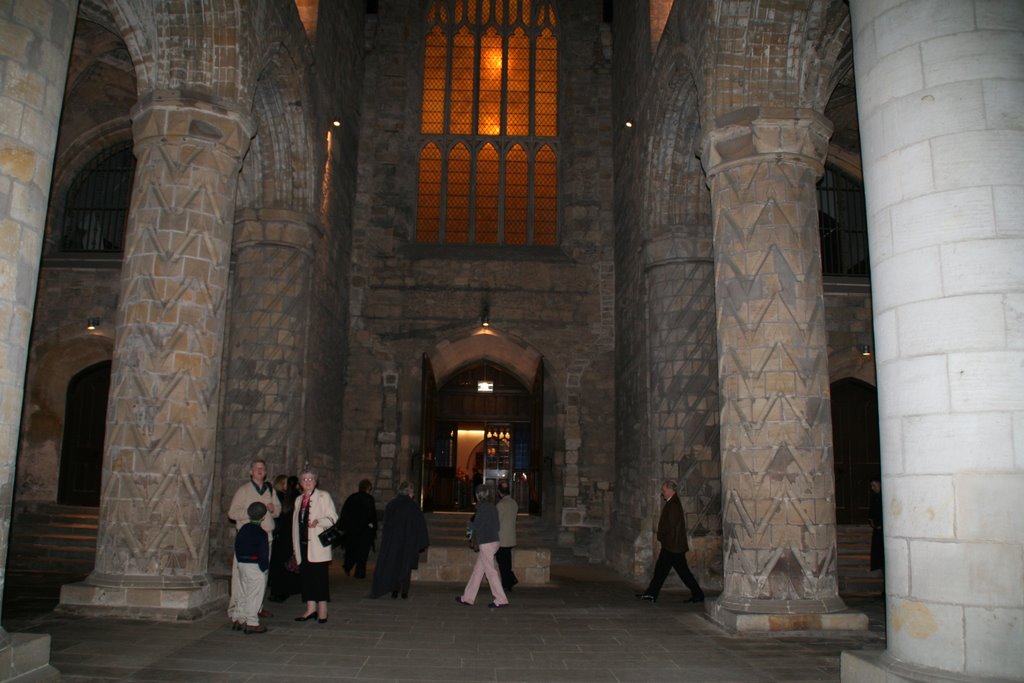
A few minutes later the huge wooden doors of Dunfermline Abbey -- doors older than America -- creaked open into the Medieval Nave, a cavernous stone space with soaring columns that upheld ceilings all but concealed in darkness. Essentially, we were in a crypt.


We wandered around reading tomb inscriptions and trying to absorb the idea of being in an edifice that has a history dating back to the 800's. Umm hello, that's before the Battle of Hastings. Our brains were wobbling.

Dunfermline Abbey oversees the city from its highest point and defines its horizon. It is ancient in a way that an American mind can scarcely calculate, and yet the sanctuary is still fully in use. Here in the states, we would probably have yanked it down long ago and replaced it with a technologically viable modern box made of faux stone, built to last a couple of decades. Over there, they revel in their oldness. It's comfortable and comforting to them.

We then stepped up into the Memorial Chapel -- which is just gorgeous. (For more photos of this chapel, go to that link for the Abbey, above.)


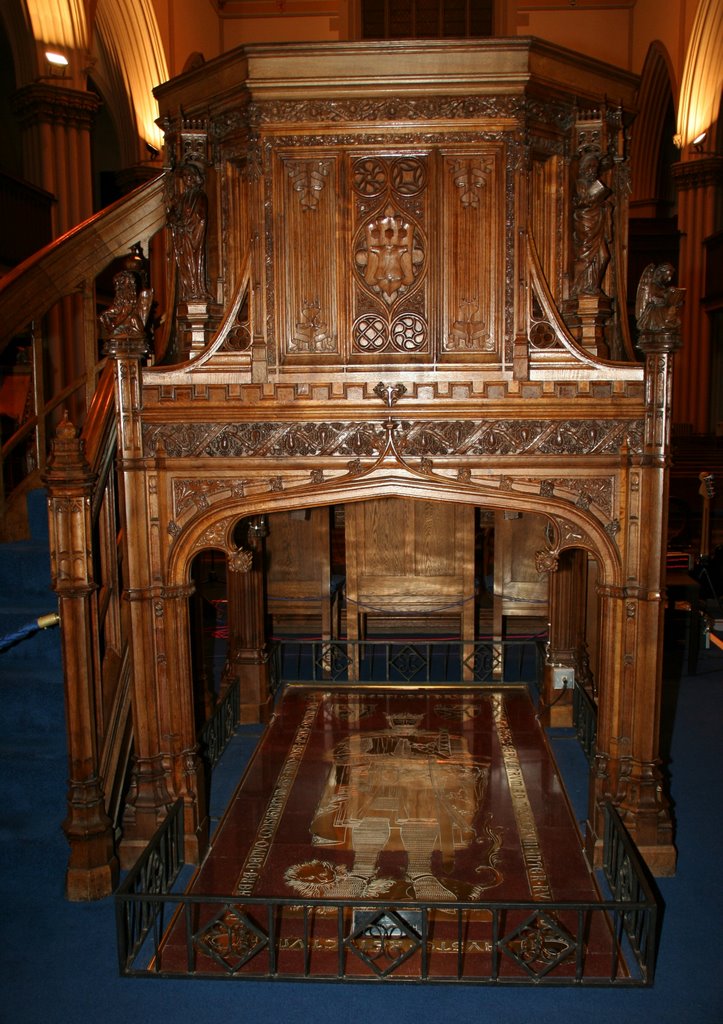
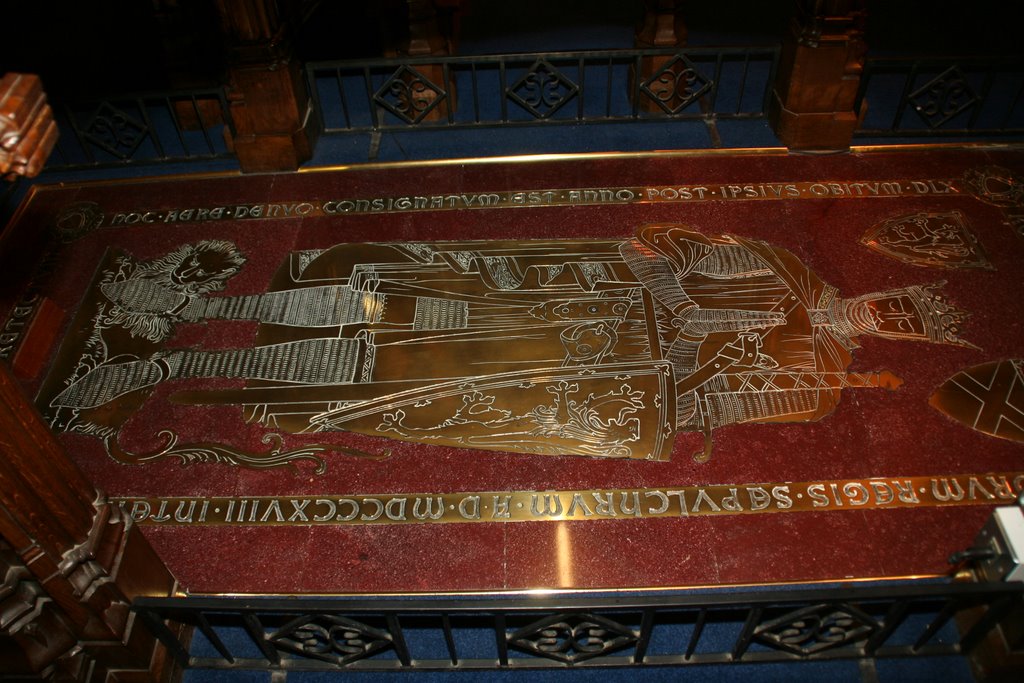
We knew beforehand that Robert the Bruce was buried beneath the floor somewhere inside Dunfermline Abbey in 1352, but what we didn't know is that his tomb is front and center in the sanctuary, right under the elevated pulpit of ornately carved wood. (Many other Bruces are buried in the transept area, in tombs adorned with marble sculptures and such.) The top of King Robert's tomb is red marble from the tomb of Constantine, if I heard correctly, inlaid with gold.


Lord Elgin related to the gathered Bruces that when Robert's body was exhumed in a chapel renovation in 1898, Queen Victoria told his grandfather - who was, of course, the Lord Elgin of that day - that she thought a huge equestrian statue would be most appropriate for Robert's burial site. But he didn't think that was quite fitting for a Scottish cathedral, and designed the tomb as it is today. I'm guessing it took a considerable amount of pluck to disregard Queen Victoria's wishes, but hey, he was a Bruce... er, I mean, a Scot.

The newspaper took pictures of all the assembled Bruces gathered around the tomb, and then it was time to settle into the ancient pews for the evening of story and song. The performance was first-rate -- a group of superb celtic musicians presented the history of Scotland through storytelling and folk songs right in front of the tomb in the darkened abbey. Words cannot convey the coolness quotient here. The atmospherics were just out of control. It was simply fabulous.

We then journeyed back across the dark cemetery to Abbot House again.

I held the camera up behind me and snapped this shot without even looking because we were running in the rain. It's a side door of the abbey; you can see the raindrops!

There we were treated to a wonderful buffet of Scottish salmon and venison, served with the obligatory root vegetables which the Brits consume at practically every meal. Tea followed, served with shortbread and something luscious called Border Cake -- a tart of dried fruits baked to perfection and ladled with heavy cream. Yet another duo entertained us as we dined - on Scottish fiddle and some sort of indigenous drums. Heavenly. We roamed around the exhibits for another lovely hour or more, and chatted up lots of nobles who, by now, were calling us "cuz."

Finally the rock star bus came rolling round to fetch us back to the hotel, where we had a precious few hours to sleep before Lord Elgin would send The Bus around for us again early the next morning...


but that will be the story of Day 3, coming up next... which was without a doubt the most amazing day of the whole trip.

May 18, 2006

Fa is 17 Today!

Happy Birthday, Miss Thing!
We love you to the moon and back!


all photos taken by The Shieldmaiden at The Arboretum, 5.18.06

May 17, 2006

"Hey yo -- Beehive people! Where is the next installment of the travel diary, anyway???"

YES, yes, yes, dear friends... it's almost done and will be posted soon, as in probably tonight. These posts are just taking longer to construct than we expected!

May 9, 2006

Day 2 - Stirling Castle addendum 1

Great Scot

One of the things that I found to be odd while driving around the Scottish countryside was how the towns and villages suddenly simply stopped. I am used to the urban sprawl which surrounds my city (and its suburbs), which seems to go on forever. Conversely, in the towns/villages that we saw, there was a distinct identifiable point where the town ended and the surrounding countryside began. I made a comment about this observation to one of Lord Elgin's sons. He indicated that this phenomenon dated back to a certain royal decree from King Robert in the 1300s regarding preservation of farm land.

May 7, 2006

Scotland, Day 2 - Stirling Castle & Bannockburn

~Q. Shenaynay

(click photos to enlarge)

Stirling Castle was our favorite castle of the whole trip. Set high on volcanic rock in the heart of the kingdom, it dates back possibly before the 12th century. As the official tour book states, it has been famously called the "huge brooch clasping Highlands and Lowlands together... symbolizing the spirit of Scotland for Scots and non-Scots alike... Without this castle, there would have been no need for William Wallace to fight the Battle of Stirling Bridge in 1297, nor for Robert the Bruce to fight at Bannockburn in 1314."

This stunning statue of King Robert the Bruce stands on the grounds outside the moat.


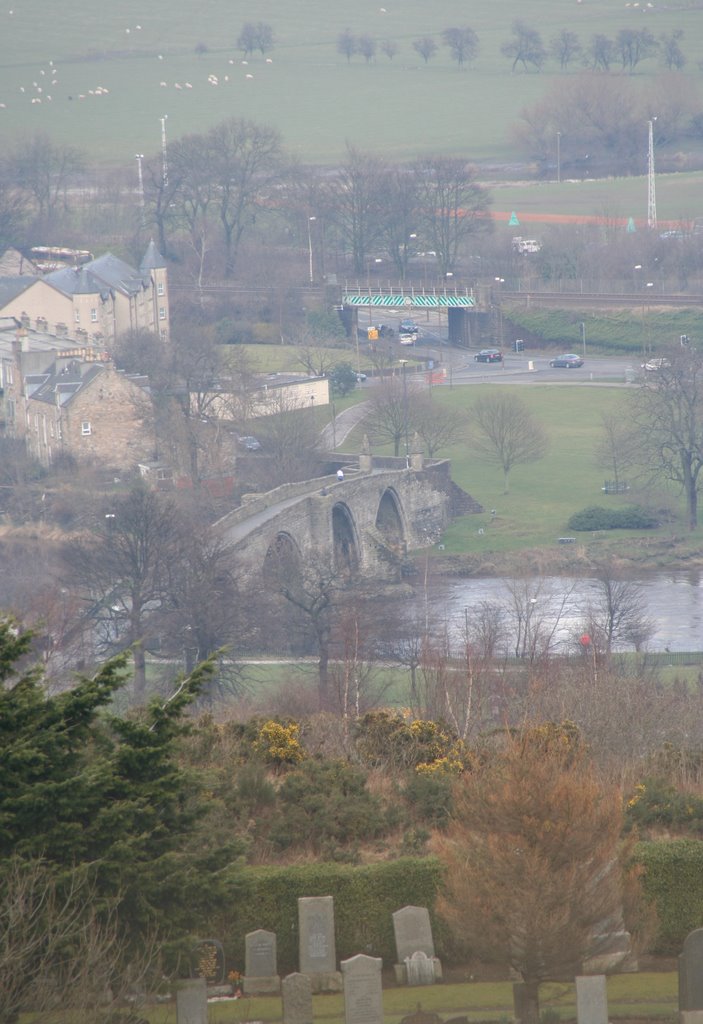
The castle overlooks the Stirling River bridge in the valley below -- a bridge that Wallace employed as the decisive factor in one of the most strategic battles of Scottish history. It really was as misty as it appears in this picture. Notice the sheep in the distance.


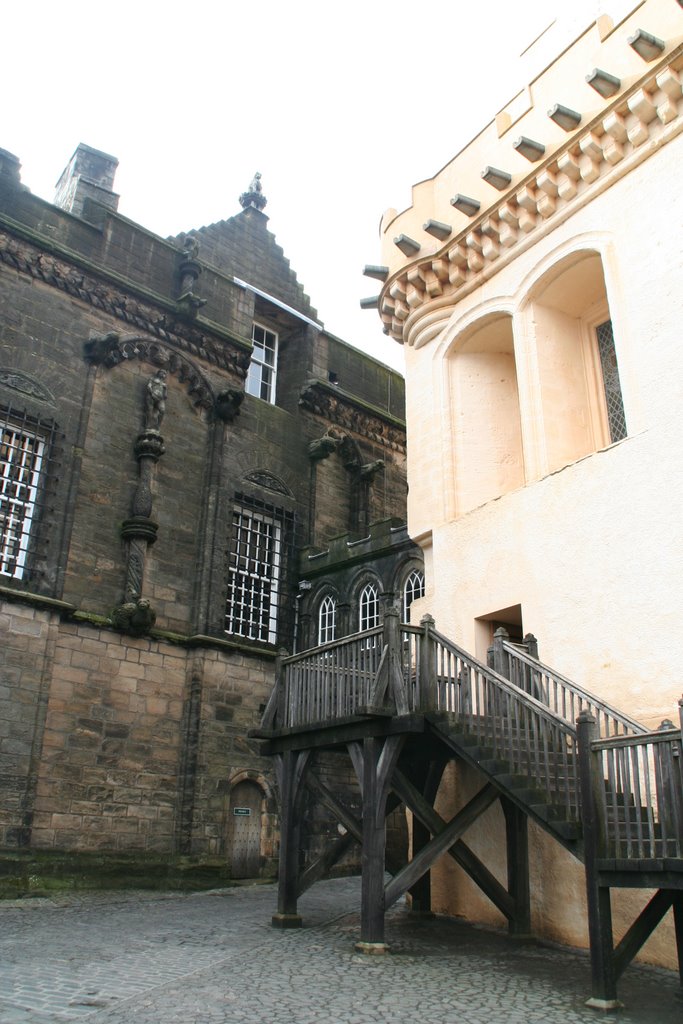
Stirling Castle is massive and surprisingly ornate. It would be impossible to get a good overall photo of the entire castle without a helicopter, so understand that these are just pictures of portions of the castle. Let me say it again: it is MASSIVE.

Trust me, everything in these pictures is at least twice as big and tall and overwhelming as it looks!


The Palace of King James V


View of the outside of a dungeon...


...and the view from the inside:


Claire said Tolkein used elements of this castle as inspiration for settings in Lord of the Rings, particularly The Great Hall in the next three pictures, which was built in 1503 by James IV to serve as the center of public and ceremonial life for the royal court. This room is cavernous... enormous.


It was so charming, so satisfying, to watch my children at Stirling Castle. They were lost to the present, wandering along stone walls deep in thought and well-fed imaginations. I would say all those years of studying British/Scottish history and reading all those stacks of great books truly paid off that one day -- the girls knew where they were. And they knew the significance of it all so much more immediately and fully than Dan or I did, which pleased me greatly.

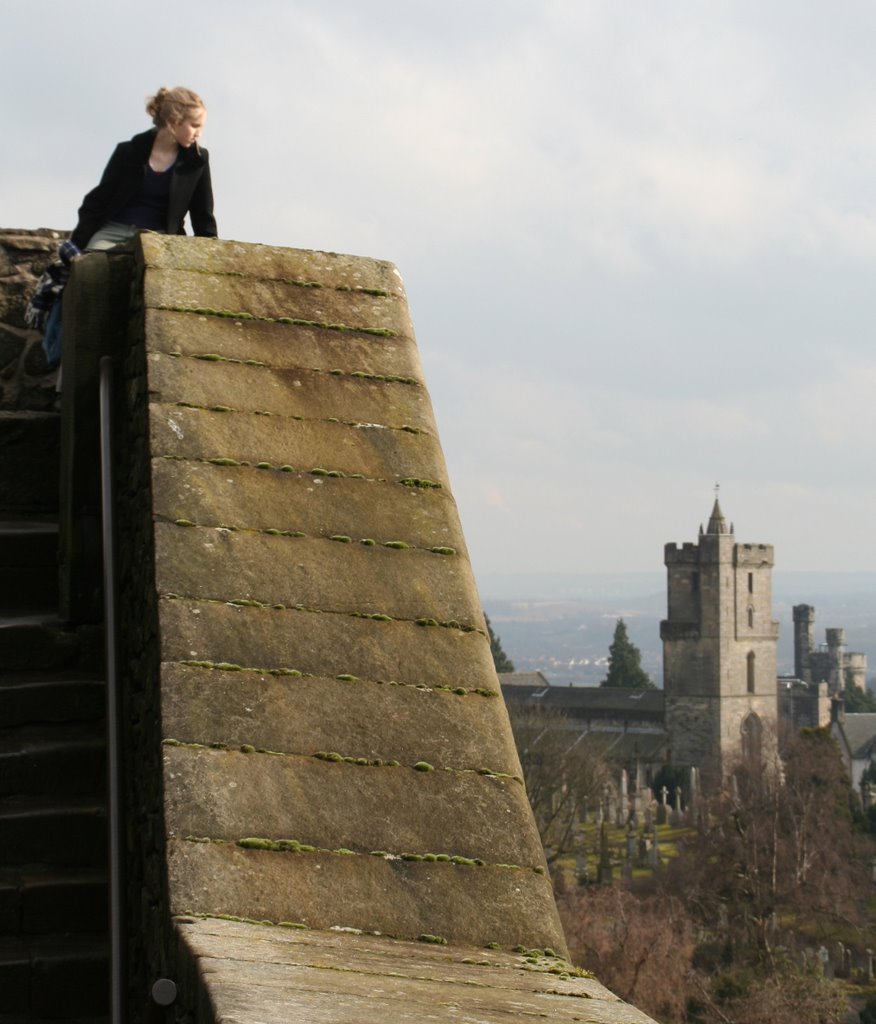
Claire muses on the wall of the Outer Defenses, where there seems to be no end to the horizon. The tower in the distance is The Church of The Holy Rude where John Knox preached...

The Shieldmaiden in a "sentry box" on the lookout for vile Englishmen... see her in the small window?


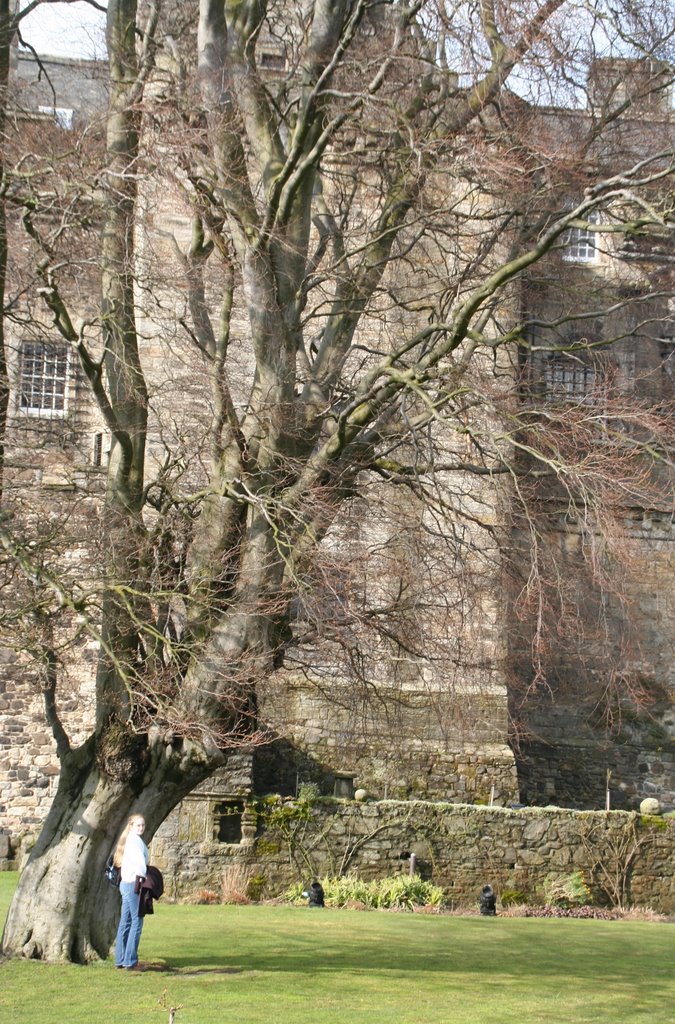
Caitlin was in awe standing under this magnificent ancient tree, looking out across the huge grassy courtyard. When I asked her what she was thinking, she said, "Oh Mamadah! Do you get it? King James IV BOWLED on this lawn!"


No, my dear, I didn't get that. But I'm so glad you did... and that way I now get to get it, too.

Funny how life turns around on you -- all these years I've spent teaching them have made them able to teach me now. I love that. You truly do get back everything you give.

We went inside the chapel where one of the six King Jameses was baptized (don't recall which), and the girls and I couldn't resist going to a corner and singing Bruce's Address, an old hymn with words adapted from Burns' poem "Scots Wha Hae" and sung to the same tune as the Scottish folk song with Burns' words. The British are so different from us, so reserved -- the small group of tourists in the chapel scarcely looked in our direction, which would never happen in America where people just seem wired to gawk and comment. But we did hear one woman whisper to her husband, "They must be from the States" -- which we suspected was either a comment about our shocking lack of inhibition or else perhaps directed at the fact that we sang the "wrong" words to what is for them a familiar national folk tune.

These castles are overwhelming to the senses. It boggles to imagine men planning and constructing these massive structures so many centuries ago, and without machinery or electricity. The stones are immense; there are untold tons of concrete, and all of it atop these impossible cliffs. Everywhere you look there are gargoyles, stained glass, carved wood elements, intricate paving patterns underfoot, patterns in the stonework.

Again, these pictures simply do not convey size... mass... texture...


...for instance, this mossy old gal is much larger than life-size...


It's astonishing that they would have bothered with all that detail and beauty in what was essentially a military fortress. But you begin to absorb after a day or two in this atmosphere that having a king around changes everything.


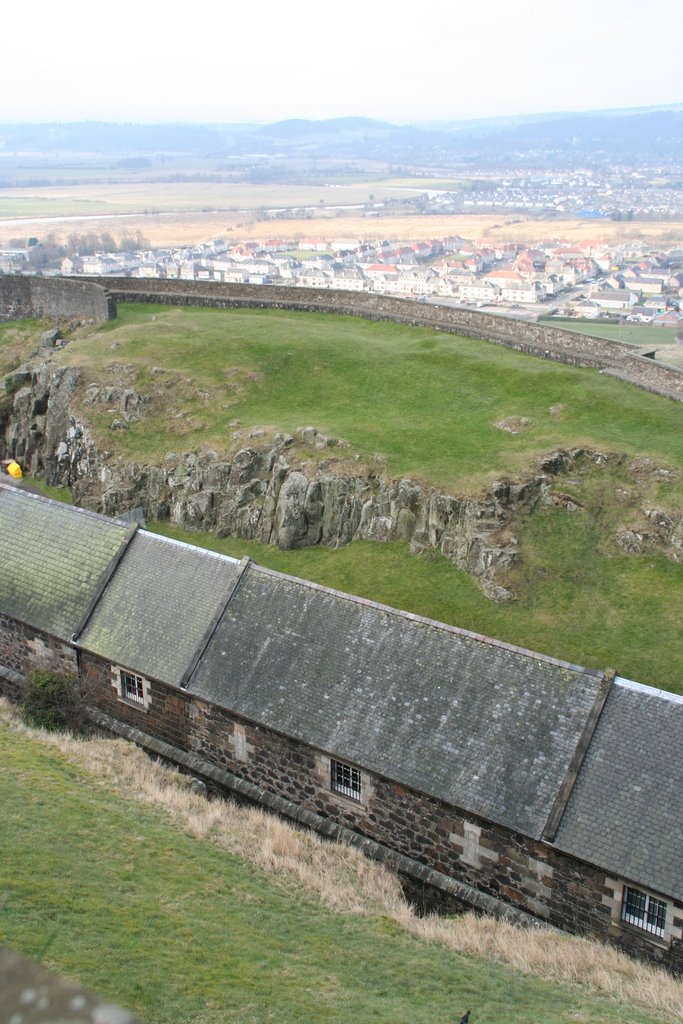
A couple of shots taken from the castle walls... this shot shows the Royal Gardens:


This is one of my favorite shots... I really like the way it almost has a geological layering effect...


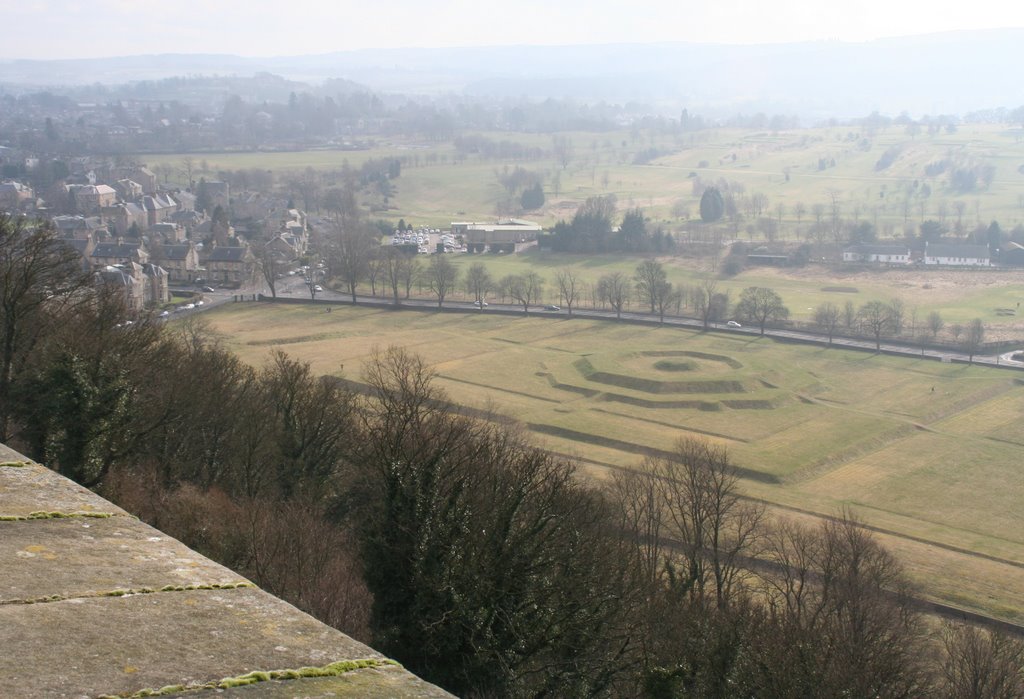
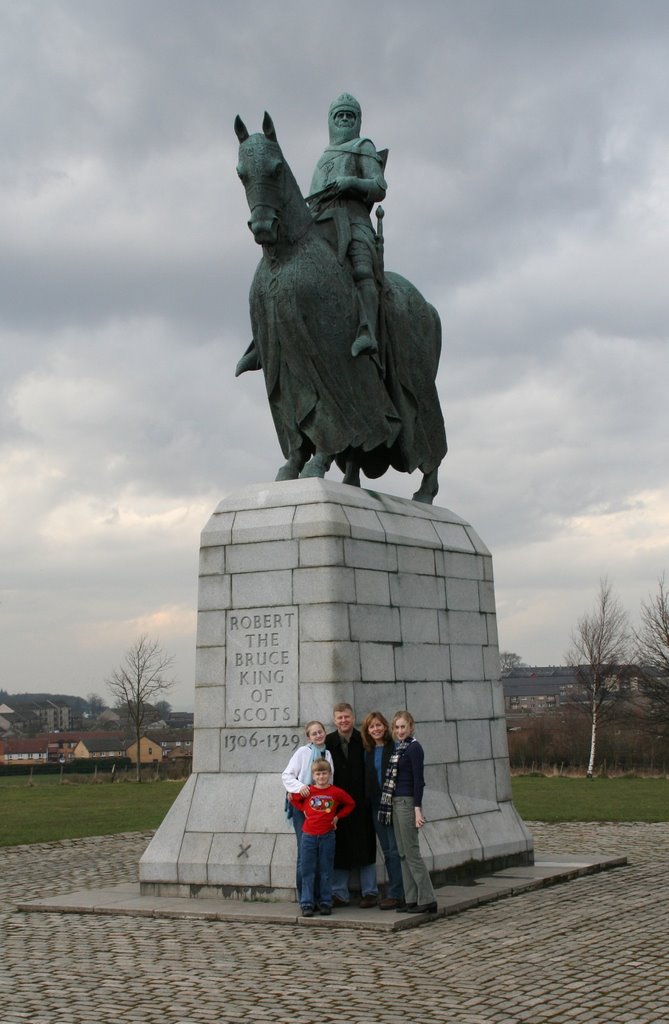
Our senses all but exhausted, we left Stirling and drove a short distance to Bannockburn, a small town surrounded by rolling farmlands. We got there right before dusk. The Bannockburn Battlefield memorial area is still mostly open and undeveloped, though you can see the burgh to one side. In the center of the battlefield is the memorial, a large open ring with flags billowing above it in the sunset, and outside the ring is the famous equestrian statue of Robert the Bruce. Oh, it's beautiful! What a thrill to finally see Dan standing beneath it like he's always dreamed of doing!

The girls and I stood near the spot where Robert declared Scotland's victory over England, and sang a Sacred Harp song. What a moment that was -- the open ring of the memorial was designed for accoustics, so that when tourists (like me!) read aloud the portion of Bruce's stirring address to his troops which is engraved on the memorial, it just THUNDERS. What a thrill! So with those acoustics, it was doubly wonderful to sing there.

Oh, since I know you'll ask... here is that quote from the address, which you can see most of in the picture below:

"WE FIGHT NOT FOR GLORY, NOR FOR WEALTH, NOR HONOUR, BUT ONLY AND ALONE WE FIGHT FOR FREEDOM WHICH NO GOOD MAN SURRENDERS BUT WITH HIS LIFE."


Well, it looks like Saturday is going to take three blog posts, because I can't even begin to cram our magnificent evening at Dunfermline Abbey with the clan into this post!

So... until tomorrow...

May 6, 2006

Scotland, Day 2, Part 1

~Q. Shenaynay~

(click photos to enlarge)

Now then, let's cut to the chase about our hotel room. New hotel, spotlessly clean. That's the good part. But... no washcloths, no bathmat, no telephone, and look Ma! -- no topsheet on the beds! One t-tiny little bar of soap. (However, there were plenty of PG Tips tea bags and a very nice hot water pot, plus ample cream and sugar. We all have our priorities!) So Great Scot went to the front desk to inquire after the missing items... and the bubblehead desk girl chirped, "Dooon 'ave 'em, sorrrry!" And then she went on to explain -- with mangled consonants sung in lilting tones -- that it was all for our own good somehow or another. Gotcha. Right.

And thus it was without a topsheet that Great Scot finally got to sleep beneath the skies of Scotland. But no matter - it was about time. We were all so happy for him! I told him I suspected his father was somewhere dancing for joy with the angels.

Next morning, we passed around the sliver of soap and valiantly resisted the evil urge to cut up a spare towel into washcloths. Somehow we managed to get spiffy enough to venture out and face the Peugeot deathtrap again. Great Scot began his chant: "Stay on the left, stay on the left." He handed me a map as though he expected me to navigate. For real. I scoffed. Ever seen a Scottish map? Well, I have. HA. (But I did try.)

We only had, oh, maybe three near-death experiences on the short jaunt into Dunfermline (remember, that's doon-FERRRRRM-lin) for breakfast, and Great Scot was feeling pretty smug about that. I was plagued with these sort of semi-subconscious gaspy panic moments over the fact that I was sitting on the driver's side (American) but doing nothing, whilst the car was nonetheless moving in traffic. My brain kept yelling at me YOU SHOULD BE DRIVING AND YOU'RE NOT!!! Weird feeling, I tell you. Hard to describe.

We found a "car park" -- a parking garage -- and crammed the deathtrap into an impossibly tiny parking space. Then we just wandered with all the other Saturday morning pedestrians down the cobbly streets of the village.

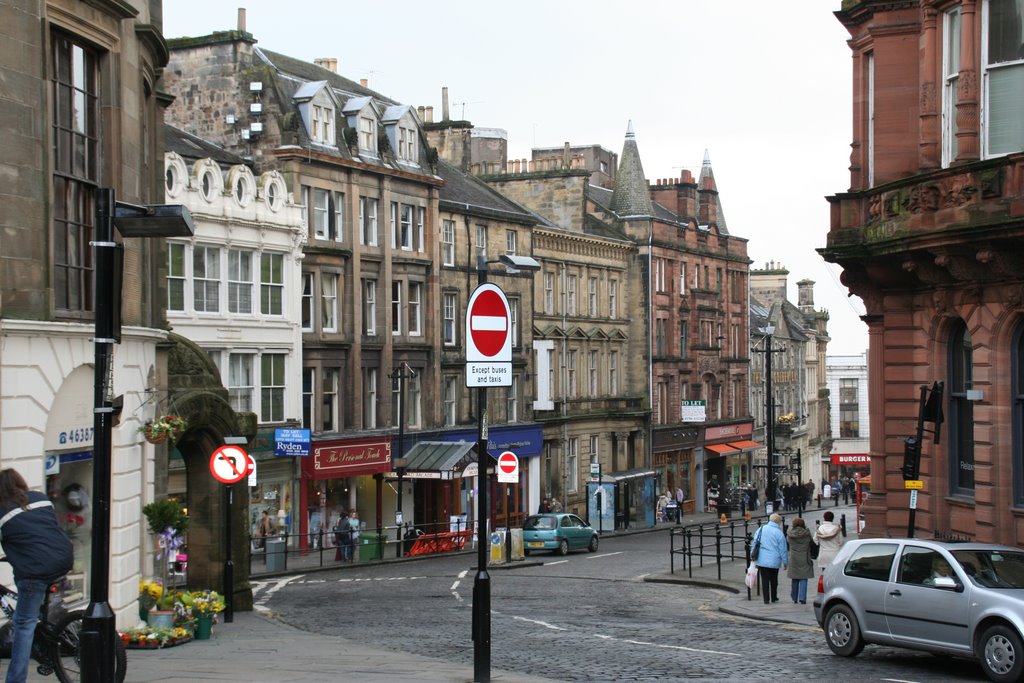
The old buildings and churches and shops are nestled up close to the rolling streets, and fascinating faces wander around shopping and visiting. We just strolled and gaped and eavesdropped. We could have listened to the Scots converse for weeks on end. So many variations in that accent!


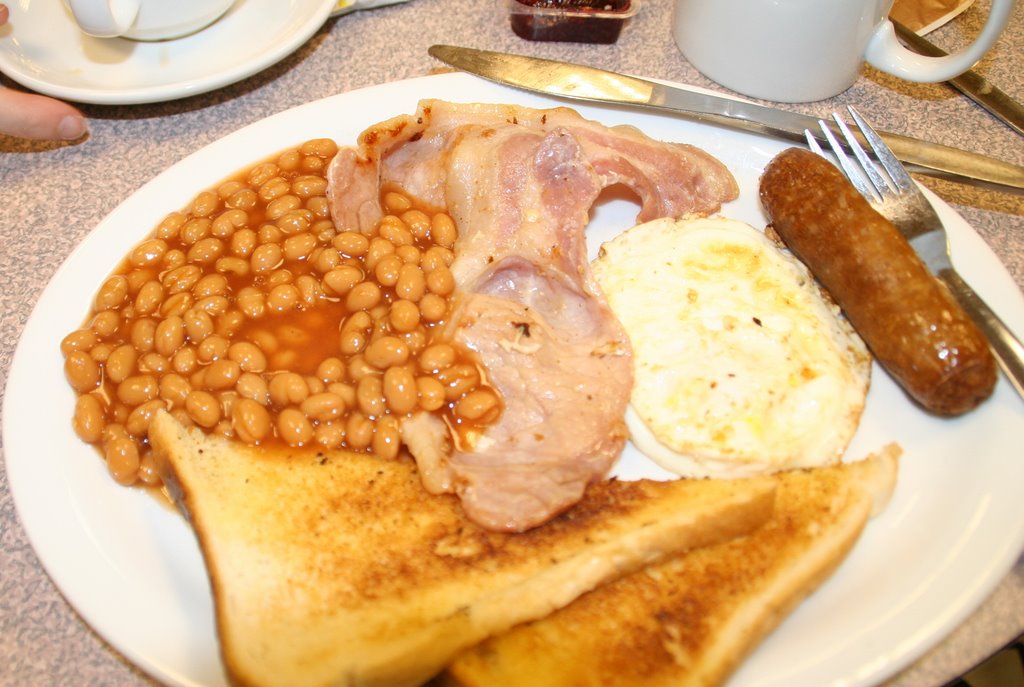
We wandered upon a little breakfast place down a side street. We got in the "queue" to order and tried to figure out fast how the words on the menu board would translate onto a plate. The rosy-cheeked counter lady just smiled patiently and blurrrrted cheerrrry verrrrbage at us that was meant to be informative, if we could only understand... ummm, English. We finally just ordered whatever we were reading at the moment. Imagine our surprise upon discovering that a typical Scottish breakfast includes pork-n-beans! That slab of hammy looking stuff in the center is what the British call bacon. It was good, but it wasn't... bacon.

Then we splurched the deathtrap out of the carpark and braved our way into the countryside to find Stirling and Bannockburn. And that's when we began to really see it.


WOW. (I'll say this again, I'm sure.) Scotland Is Beautiful.


Wow.

Here's a passage from my journal that day:

We could spend weeks exploring the Scottish countryside and the little villages. We sort of got a little lost today, which was fun, and wound up on a bona fide scenic route that led through tiny little villages along the river Forth. The roads obviously evolved from ancient horse paths because they are so narrow and winding, and many of the buildings are so close to the street that you feel you could almost touch them out the car window.

(To give you a feel for it, look at this picture I took from inside the car. You can see the registration sticker on the window.)

We truly feel like we have stepped right into the pages of some old book. Everything is so old, so stoney, so heavy. There are no billboards, no lights on the roads -- the sight of neon would be a shock here.

The trees are gnarly and twisting and covered in bright emerald moss; they look tricksy and sneaky, like they just might move when you look away. They are not leafed out so I don't know what sorts of trees they are, but their bare bones are unfamiliar to me. The rivers have a silver cast, and a Brigadoon-ish mist floats in the air.

The smallest cottages in the smallest villages are tidy and have well-tended herbs, shrubs and flowers. The Scots keep up their homes regardless of socio-economic strata, it appears. (Even the two trailer parks we saw in Scotland -- called "Caravan Parks" -- were neat as pins and, oddly enough to American eyes, they were right on the coast.)


Stirling Castle! We all gasped when it first came into view on the horizon, and it was still many miles away. (This photo was taken about a mile away!) It sprawls along the span of the highest point in the region, a sheer rock cliff that appears impossible for any living being to climb. And yet William Wallace and his men did so when they stormed it over 700 years ago.


Stirling is charming, astonishing, beautiful... we ascended up winding stone streets past one magnificent structure after another, past dozens of statues and World War I memorials, until we made our way up to the castle mount.


I couldn't stop snapping pictures -- I could have used up a whole gig on shots of stonework details and architectural elements alone!


Near the castle we found the path to The Church of The Holy Rude (which gave us a big chuckle) where John Knox preached. The adjacent cemetery was something right out of a Dickens novel -- mossy and rolling and full of towering ancient tombstones and rocky cliffs. Fascinating.

We had salmon "shammiches" and such at The Portcullis, a luscious old pub in a former grammar school for elite young men. A plaque on the wall helpfully noted that although the headmaster was a noted scholar of the 1700's, Robert Burns thought him a pedant. Ouch. It was here that we first encounted the British custom of serving potatoes with potatoes -- our lunches came a small baked potato AND with chips (somewhat like french fries but thicker and less salty). We learned quickly that chips are served with everything.

From there we trekked up to the castle. WOW, what a castle! It was our favorite castle of the whole trip. In fact, we have so many wonderful pictures of that, and of the remainder of Saturday, that I think it best to divide Saturday into three posts lest Blogspot rebel over too many photos at once.

So, I'm off to write about the next adventures of Saturday... Stirling Castle & Bannockburn!

May 5, 2006

Scotland, Day 1, Addendum 2

Fa-So-La-La

Excerpts from my travel journal--

On the plane to New York--

"I love the feeling of riding buses or walking through the airport with all your luggage. You have absolutely no context-- you could be Anyone doing Anything. When I was a child I used to spend every moment in an airport pretending I was someone else doing something very exciting and important, and today I caught myself doing it again several times. You'd think that starting the journey to Scotland would be enough to keep me in the moment, but apparently it isn't. Ha."

"This is all so unreal. I can't get it through my head that tonight I will go to bed in Edinburgh, walk and breathe in Scotland. I have this feeling like we'll have to go through a wardrobe or down a rabbit hole or something fantastic like that just to get there. Surely one doesn't go to Scotland simply by boarding a plane?"

"We're in the New York airport now, one and a half hours into our our three-hour layover. This place is huge, crowded, and dirty, and the people are rather rude. But it is exciting to sit in a gate where the sign says 'Edinburgh.'
It's dark out, and we walked around the airport until we found a window where we could see the Empire State Building, where we began singing 'An Affair to Remember' and swooning appropriately that we were looking a somewhere Cary Grant had been. I mean, forget the Statue of Liberty... haha."

In Scotland--

"This place is so beautiful. It's craggy and rolley and green-grey-brown and all up-and-downy. The hillsides are tumbley and some of them spring up out of nowhere, just a sudden random hump. The grass (or whatever this stuff on the ground is) is all puffley, which is not a word but sounds like the grass looks. There are crocus and daffodil everywhere, and the fields really are separated by hedges, just like in the picture books and movies. There are low stone walls around everything."

"So now we're lost in a neighborhood in Dunfermline, which I'm actually rather glad of. I like seeing the normal places, where people really live. The houses are tiny, in shape roughly resembling Monopoly hotels. They look like some giant just tumbled them around until they all landed right-side-up. No straight, organized streets here. They have almost no yards, but most do have a small garden or flowerbed. The cars are literally parked on the sidewalk, because there is no room for garages except for in the more expensive homes."

"Edinburgh Castle was an incredible experience. I'm so glad I read all that Scottish history before we came. I was able to understand the significance of it all when they talked about the people who have been here-- Robert Bruce, William Wallace, Oliver Cromwell, William of Orange, the Jameses and Charleses, Mary Queen of Scots, Protestants and Catholics, Hanovarians and Jacobites. To think that I was looking over the same ramparts and climbing the same stairs as all those people!-- it was almost overpowering. And then even aside from that is the wonder of being in a place that has seen so much, and of imagining what it would have been like-- to stand in a window and imagine being imprisoned or besieged inside these walls, or to look over the high windy walls and imagine away the modern city below and see hordes of charging armies approaching. 900 years of history have passed, 900 years of people have stood where I stood this afternoon."

Scotland - Day 1 (addendum 1)

Great Scot

What really struck me on our first day, was how utterly different everything was. The signs, the roads, the look and feel of everything were setup in a way that we were not ready for. As an example, the road signs are principally based upon where the road ends up, instead of highway numbers like it is here in the US. So, if you don't know the area pretty well and the names and directions of the towns that surround your location (like us on that first day), you are in for a number of wrong turns. One quick aside, while the roundabouts in UK may be more efficient for keeping traffic moving, they simply scared me to death. Each time that I approached one (whether it be a "major" or "minor" roundabout), every muscle in my body clinched.

One thing that I was very pleased to note on that first day was how welcoming and kind the people that we met were. It was obvious that we were visitors (given the glazed over looks of exhaution and bewilderment), however, people went out of their way to assist us. Additionally, unlike the people we later saw in London, the people that we came across in Edinburgh had a happy countenance. I think it must be the haggis (or perhaps it is something else)!

May 4, 2006

Scotland, Day 1

~from all of us~

At long last, we are ready to begin blogging about our trip to Scotland and England! Thank you all for being patient with us... some more than others. ;-) We're planning to post one day of the trip at a time with pictures from that day, probably one post per day over the next couple of weeks.

We warn you now: this post is much, much longer than the rest will be!


We have long dreamed of a family pilgrimage to Scotland, and always thought we might go when Fa graduates next year. However, when we learned that March 2006 was going to be the 700th anniversary of the coronation of Robert the Bruce as the first king of Scotland, and that some once-in-a-lifetime celebrations were being planned in Scotland to commemorate that great event, we decided to start tossing our pennies in the proverbial jar and go a year earlier than planned.

We spent this past school year studying Scottish history, getting acquainted with the figures of the Scottish Reformation, reading Robert Burns and Sir Walter Scott, and learning about Scottish music. (We had already spent some years studying English history and literature, so we felt fairly well prepared to enjoy England.)

The day finally arrived, and we flew to Newark to catch our connecting flight to Edinburgh. We were thrilled to fly over the Statue of Liberty -- a tiny green doll rising from the water -- and the Manhattan skyline.

Waiting in New Jersey to board the plane for Edinburgh, we began to suspect that most of the other passengers in our flight gate were Scots. They just had a different look about them. We began to make a sort of game out of guessing which passengers were Americans. (Little did we know there were Bruces from Georgia on the plane who were flying in for the same thing we were!)

We began to wonder -- what IS it that makes Americans look American? This was a conundrum we puzzled over for the next two weeks. More on that in blog posts about the following days of the trip.

The overnight flight was about 7 hours, and we needed desperately to sleep because we would be landing at 9 am. What a joke. People were not meant to sleep on planes, at least not without medical intervention. So we slogged through the night with one eye open, realizing more with each passing wakeful hour that we were going to be wrecks the first day in Edinburgh. But we figured excitement and adrenaline and coffee would make up for lost sleep!

I glanced at the map on the in-flight screen at one point in the night and almost fainted to learn that the temperature outside the plane was 87 below zero. I really didn't need to know that.

We travelled almost 5000 miles that day. Amazing.

We knew we were not in Kansas anymore as soon as we deplaned in Scotland. Our first cultural chortle happened when we went to find ladies' restrooms in the airport. Restrooms in GB are labelled "female toilet" and "male toilet." In our jet lag stupor, that struck us really funny. We heard a woman on a cellphone telling her friend that she was "in the toilet." Ahem. Oh, and we especially liked the standard signage for handicapped restrooms: "Disabled Toilet." First time I saw one of those, I thought it meant the commode was out of order.

One of the first native Scots we saw was a female chauffeur, middle-aged but stuffed in a tight, punkish black leather suit, spikey hair bleached almost white and dark red lipstick, holding up a large sign that said "Massey Castle." She looked so bored with it all. We just had to wonder about that castle.

Due to a moment of Great American Insanity, Great Scot rented a car for our week in Scotland. When they tell you all that stuff about the British steering wheel being on the wrong side and how they drive on the left, let me tell you that is not the whole story. Your mirrors are also reversed, and the gear shift is now in your left hand, which has to think "parallel motion to my right hand shifting patterns" rather than just mirroring the motions of a right hand shift, which is what the brain wants it to do just by reflex. So everything is scrambled, not just the steering wheel and the road. And I won't even try to describe the sensation of seeing trucks barreling around corners at you on the right hand side of the road while your brain is tricking you into thinking YOU are also in that lane. I just don't want to remember that part.

Furthermore, until we actually saw it for ourselves, we didn't really get the notion that there are almost no intersections nor traffic lights in Great Britain. Instead there are roundabouts everywhere. You work up the nerve to venture out into one of these death donuts and start whipping around in circles wondering "what do I do nowwwwwww???" And then you figure out that you're just supposed to know which of the offshoot roads to zip off on, while other vehicles are spizzing all around you and honking peevishly.

And the road signage! It's all unfamiliar and hard to decipher. Just for one example among many, the orange triangle that says in alarming letters QUEUES LIKELY FORMING! Uhhh. OK, so we'll be on guard for... we can only guess what. And the lanes are VERY narrow. So all in all, driving in Great Britain is, for an American, pretty much one Prozac moment after another. Great Scot was finally beginning to get the hang of it by the time we turned the car in six days later to head to England. At that point, we had learned to truly appreciate the privilege of whipping out our Britrail train passes, then sitting back and ordering a cup of tea to sip over RELAXED conversation. Whew.

It didn't help that at the time we got the car, we were sleep-deprived and not exactly firing on all pistons, if you know what I mean. I think we went 30+ hours without sleep that first "day."

By the time Great Scot managed to maneuver the car into Edinburgh without killing us and half of Scotland, we were needing lunch badly. We parked the Peugeot deathtrap and decided to walk till we found a lunch place. We tried to understand the Scottish counter girl. She didn't seem to have the proper ratio of consonants to vowels in her life. We tried to understand the sandwiches. We tried to figure out what all those weird drinks were and how people function without iced tea. We finally just ordered some mystery sandwiches and four tall mochas and a hot chocolate. Figured we needed stimulants anyway.
Edinburgh was COLD. COLD, I'm saying. Somehow it had escaped our notice in geography class that Scotland is on the same latitude as northern Canada. COLD. Did I say that already? And mizzlish all the time -- it rains without notice, and without the Scots seeming to notice -- they just walk in it like it's not happening. We actually saw people carrying folded "brollies" in the rain instead of using them. We were whipping them out at the slightest provocation. Silly Americans.
We found the people in Edinburgh, and in fact throughout Scotland, to be very friendly and helpful. We were just swimming in the accents -- some so thick we could barely recognize them as English!

We were surprised to find how much more we liked the clothing in Scottish stores than what we typically see in American stores -- women's clothes there are so pretty, so colorful and feminine, and beautifully made. If the exchange rate had not been so terribly high, we could have gotten in a LOT of trouble buying skirts and such.

This picture is of a typical street in Edinburgh -- the buildings are centuries old, and they feel substantial. The architectural detail is complex and almost overwhelming. There are statues every few yards! Except for the cars and the merchandise in the windows, the streets probably look pretty much like they did in Sir Walter Scott's day. This street is mentioned in his book "The Antiquary," which we just read.


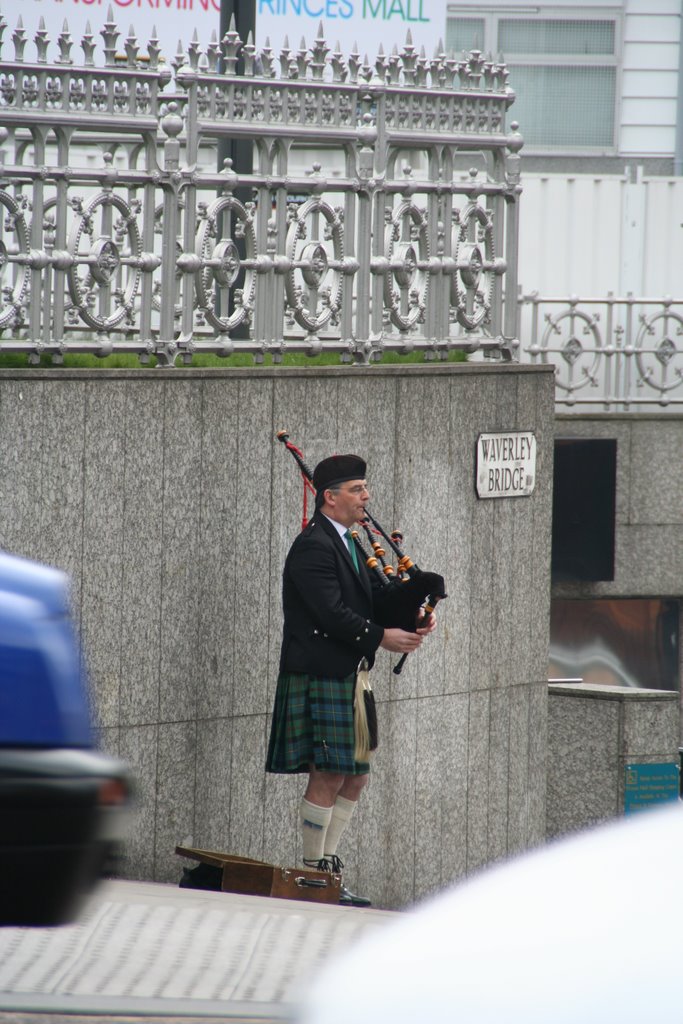
There's a lot of music in the streets of Edinburgh. Bagpipe tunes waft on the breeze and weave into the background of your thoughts. We saw this piper at the base of the castle hill. Later we happened upon a violinist playing the winter movement of Vivaldi's Four Seasons on a picturesque side street.


We meandered up to Edinburgh Castle... which is jawdropping incredible. It spans the top of an imposing cliff above the city, and seems to be hovering whenever you look up. This photo was taken from a great distance, and doesn't begin to hint at the immensity of the castle nor the height of the cliffs it rises from. You could fit several football fields atop that hill.


It was so cold on that cliff that our lungs winced when we breathed. The wind blew my umbrella inside out! We toured the castle until the cold rain drove us into the gift shop... there we were in multiple layers and heavy coats and utterly miserable, and there were these Scotsmen in kilts and Prince Charlie jackets with bare legs just visiting comfortably with one another beside the cannons. They just don't notice the weather!

Here are some shots of the castle. The statues flanking the entrance are Robert the Bruce on the left, and William Wallace on the right. It's so hard to convey a sense of scale in pictures... these statues are quite a bit larger than life size.


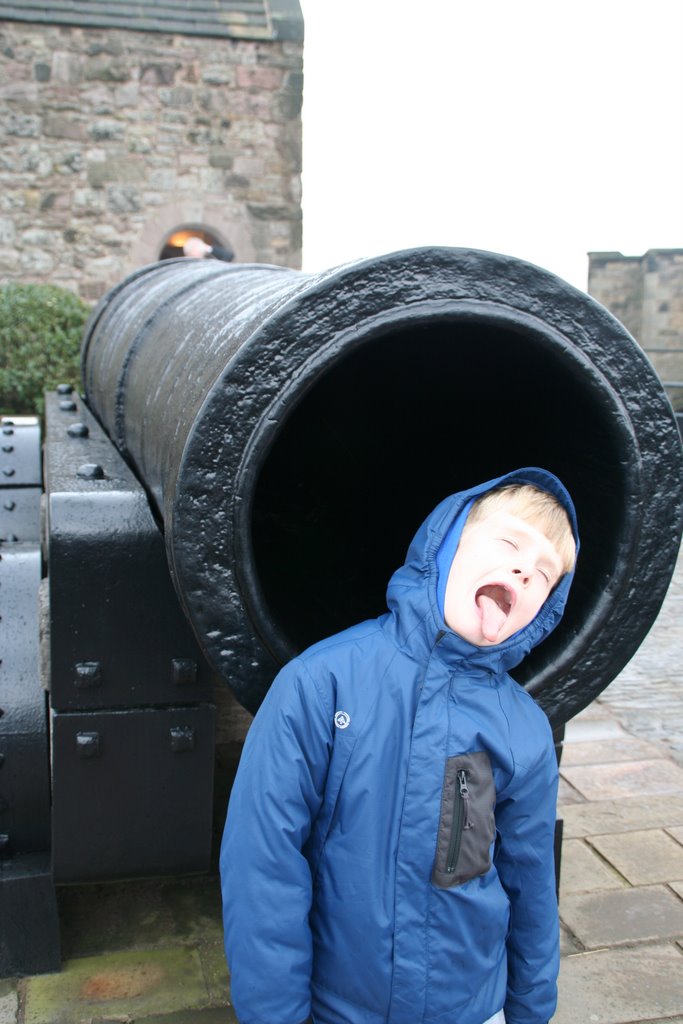
This cannon inside the castle walls was Spuddy Buddy's favorite thing on the whole trip, I think. It was the biggest cannon we saw on the whole trip -- and we saw lots. The last time it was shot, back in the the 1500's, the cannon ball was found two miles away. We saw the cannon balls, which were about 2 feet in diameter!


We were pretty much zonked at that point, so we piled back into the Peugeot deathtrap and risked our way north across the Firth of Forth bridge -- one of the loveliest bridges I've ever seen -- into Dunfermline, where our hotel was. We learned pretty quickly that we didn't have a clue how to pronounce that name. We had been saying DUN-firm-liiine. No. No. Doon-FERRRRM-lin. There ya go. We hoped for a great night's sleep, as tired as we were... but our bodies were telling us it was merely noon. Needless to say, we tossed and turned most of the night, but somehow managed to get enough sleep to get us through the next day, Saturday... which was one of the most amazing days ever.

But that will have to wait till tomorrow.